
Desconegut's avatar

Quant a NACIONALITATS & POLÍTICA

Blog del Grup de Recerca en Estudis Nacionals i Polítiques Culturals (GRENPoC), adscrit al Grup de Recerca en Estudis Polítics, les Identitats, les Institucions i la Corrupció (GREPIIC)

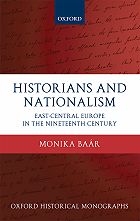
Els historiadors i el nacionalisme

La historiadora hongaresa Monika Baár, professora a la Universitat de Groningen (Holanda), el 2010 va publicar aquest interessant estudi sobre la relació entre la historiografia romàntica i la construcció del nacionalisme a l’Europa de l’est durant el segle XIX. Hi fa una anàlisi compara de la vida i l’obra de cinc destacats historiadors orientals que, com ella mateixa diu, han estat pràcticament absents del cànon de la historiografia europea. No és l’únic cas, perquè això mateix es podria aplicar a totes les historiografies que no han accedit al mercat global mitjançant una bona política de traduccions. Baár, doncs, tracta de restablir l’equilibri perdut i ens presenta cinc historiadors europeus orientals: Joachim Lelewel (Polònia, 1786-1861); Simonas Daukantas (Lituània, 1793-1864); Frantisek Palacký (República Txeca, 1798-1876); Mihály Horváth (Hongria, 1804-78) i Mihail Kogalniceanu (Romania, 1818-91). A partir de comparar els esforços d’aquests historiadors per promoure una visió unificada de la respectiva cultura nacional, Baár exposa les estratègies de cadacú per contribuir-hi. Basant-se en documents prèviament traduïts a l’anglès, Baár reconstrueix el rerefons intel·lectual comú i quins eren els seus objectius nacionalistes. L’obra vol demostrar que els historiadors del que a partir del 1945 es va convertir en la perifèria europea , en canvi al segle XIX havien fet contribucions significatives a la historiografia continental, fins al punt de ser tant o més determinants que les contribucions dels historiadors  de l’Europa occidental i central.

Aquí teniu l’índex del llibre: Introduction
;1: Five Biographical Profiles; 2: Romantic Historiography in the Service of Nation-building; 3: Institutionalization and Professionalization; 4: Intellectual Background; 5: Language as Medium, Language as Message; 6: National Antiquities; 7: Feudalism; 8: The Golden Age; 9: Perceptions of others and attitudes to European civilization; Conclusion; Bibliography.

Referència: Historians and Nationalism. Esat-Central Europe in the Nineteenth Century, Oxforf University Press, Oxford: 2010, 340 pp.

Conferència del M.H. President Artur Mas

Conferència del M.H President de la Generalitat de Catalunya, Sr. Artur Mas, sobre la sortida catalana a la crísi econòmica. Va tenir lloc en l’acte d’inauguració del Seminari Internacional Les petites nacions en un context de crisi. Buscant la sortida, que va tenir lloc a Barcelona el 25 de maig del 2011.

>Independence would not be so harmful after all

>

Financial Times

Professor Pankaj Ghemawat presents a rather bleak vision of what might happen to the Catalan economy after a secession from Spain (“The ties that bind Catalonia”, June 17th, 2011). A 7 per cent reduction of GDP is not a minor bruise after all. Nevertheless, he is not giving the whole picture because, although he mentions Catalonia’s net fiscal transfers to the rest of Spain, he fails to provide the most relevant detail about them: they stand somewhere between 8,7 and 9,8 per cent of Catalan GDP (these are the latest estimates for 2005, coming from the Spanish and the Catalan government respectively). Apart from this first consideration, we would like to make three different additional points that might show a rather less pessimistic picture of the economy of an independent Catalonia.

First, Professor Ghemawat makes the hypothesis that secession would cause a two thirds drop in trade intensity between Catalonia and the rest of Spain. This figure is based, as far as we know, on results coming from research on the effects of independence on post-colonial trade. However, the data used in this research comes mainly from the dismantling of European colonial empires throughout the XXth century and the dissolution of the Soviet Union in 1991. It is hard to draw any parallels between the economic, political, and social landscape in Catalonia today and that of African and Asian colonies fifty or sixty years ago or former Soviet republics in the 90’s, so this figure risks being a misrepresentation of the true reduction in trade intensity and should be taken with great caution.

Second, our own research on the economic consequences of secession focuses on the impact of a hypothetical trade boycott in the Spanish markets against Catalan products (and vice versa). We argue that this would be the main potential cause of a reduction of trade between Catalonia and the rest of Spain. Our conclusions indicate that the level of boycott needed to cause a drop of GDP close to 7 per cent is much higher than what could be reasonably expected, given previous similar episodes of boycotts due to political reasons both in Catalonia and elsewhere.

Third, and most important, the potential negative consequences of the reduction of Catalonia’s trade with Spain on Catalan GDP should be considered at worst an upper bound of what would occur if the Catalan economy were so inflexible that did not allow for any degree of trade diversion after the secession (by the way, this point is also applicable to our own research). Any reasonable macroeconomic model will tell you that output is determined in the medium run by factors such as the availability of labour, human and physical capital and public infrastructures, innovation potential of firms, entrepreneurial spirit, etc. Thus, it seems much more important for a secessionist country to make sure these growth factors will continue in place, rather than keeping the commercial ties with its former partners. Given the relationship between some of these factors and the level of public expenditures (e.g. public infrastructures and human capital), there is little doubt that the elimination of a net fiscal transfer to the rest of Spain of more or less 9 per cent of GDP would increase not only Catalonia’s income in the short run, but its growth prospects in the medium run.

Xavier Cuadras-Morató and Modest Guinjoan are Associate Professor and Lecturer at Universitat Pompeu Fabra (Barcelona) and authors of the book “Sense Espanya. Balanç econòmic de la independència”, 2011 (Ed. Pòrtic).Pòrtic).

>Newsletter de l’Institute for Minority Rights

>Dins el grup d’instituts de recerca de l’European Academy of Bolzano (EURAC), l’Institute for Minority Rights es dedica a la recerca sobre protecció de minories, diversitat cultural en els processos d’integració europea i resolució de conflictes ètnics. Recentment acaba de posar en circulació un newsletterper difondre la seva activitat acadèmica. En aquest primer número es tracten temàtiques com la protecció de minories a l’europa central, la qüestió del poble gitano a Sèrbia o el desenvolupament de la identitat en minories territorials receptores d’immigració durant els darrers anys. Per subscriure-us cal contactar amb l’institut.

>Estrena del documental sobre La Crida a la Solidaritat

>El proper dilluns dia 20 s’estrenarà a la Sala Escarré del CIEMEN un documental sobre la història del moviment La Crida a la Solidaritat. El reportatge serà emès també pel Canal33 el proper 24 de juny a les 23:15h.


Tràiler del documental “La Crida, Història d’una resposta” from Zeba Produccions on Vimeo.

>IN TRANSIT. Eurocatalan newsletter

>Money Matters

It seems like a new problem, but it isn’t. It is actually an issue that has never been properly resolved between Catalonia and the Spanish State: the fiscal deficit. The enormous difference between what Catalonia pays the central government and what Catalonia receives in return has been a common thread throughout history. There are many incidents that offer convincing proof of this imbalance all the way up to the present.

For example, in 1843 Lo Verdader Català (‘The True Catalan’) was launched: a magazine dedicated to denouncing Catalonia’s economic problems. The cover of the first issue shows a disheartened Catalan and the following caption: “On the ground the Catalan observes his industry, commerce, and agriculture with sadness.” The magazine went bankrupt almost immediately due to a lack of funding and because the founders came under significant pressure. It wasn’t until the beginning of the 20th century that the economist Guillem Graell became the first person to carry out a careful study of the uneven fiscal balances and… he felt a chill when he saw how much discrimination Catalonia suffered from. The arrival of the Second Republic didn’t solve anything either. And paradoxically, in the middle of Franco’s dictatorship in 1961, a young economist, Ernest Lluch (future Minister of the Socialist Government of Felipe González) asked himself: “does Catalonia exploit Spain?” The answer he found was that although 25% of Spain’s tax revenues came from Catalonia, only 45% of the Catalans’ contributions were returned to Catalonia, thus making it impossible for the Catalans to fund adequate economic and social services. In 1967, the first exact figure of the fiscal deficit is supplied by Ramon Trias Fargas (future Finance Minister of the first democratic Generalitat of Catalan President Jordi Pujol): 15 billion pesetas.

The Spain that sails into democracy disembarks with the economic and social formula ‘café para todos’ (‘coffee for all’). It is an unequal, imbalanced, model that waters down autonomies like Catalonia. The result is that today Catalans suffer a fiscal deficit that has reached 18 billion euros, some 2,400 euros per person each year. What does this mean?

Historically, with the Catalans’ money the rest of Spain has been able to pay for improvements in social services, infrastructure (highways, TGV, etc.), and social well-being (schools, hospitals, etc.). Said differently: they have become modernized and have moved closer to Europe. But now, futher accentuated by the economic crisis, Catalonia is watching and agonizing over how the fiscal deficit is suffocating it more than ever. It is sensing how the autonomous system is slowly leaving it with less and less oxygen. Could we then say that the ‘State of the Autonomies’ is a product in a ‘bad state’? The articles that appear in this issue of InTransit show us – from different perspectives – how the fiscal deficit (a key factor in the crisis of the autonomies) is a very real and grave problem for Catalonia. Maybe something has gone awry when a part of Europe, well into the 21st century, continues to practice the same politics it has been using for centuries.

http://www.it-intransit.eu

>Fight of the Century: Keynes vs. Hayek Round Two

>

>"Fear the Boom and Bust" a Hayek vs. Keynes Rap Anthem

>

>Pànel sobre la unitat d’Itàlia al congrés italià de ciència política

>El proper congrés de l’Associació Italiana de Ciència Política, que se celebrarà a Palerm entre el 8 i el 10 de setembre, inclourà un pànel sobre la tensió centre-perifèria en el procés d’unificació italiana amb motiu del 150è aniversari que se celebra enguany. Teniu més informació a la pàgina web del congrés:

1861-2011: Unità d’Italia? Il cleavage centro-periferia nell’Italia del XXI Secolo

>Carta del Congrés Mundial Amazigh als Eurodiputats

>

Mesdames et Messieurs les Eurodéputés,
Nous joignons ci-après notre dernier communiqué de dénonciation de non respect des droits de se manifester pacifiquement par les autorités marocaines qui ont utilisé une violence inouï et dont a été victime notre président du Congrès Mondial Amazigh, M. Brahim Benlahoucine.
Nous vous informons que les autorités marocaines ont libéré dernièrement divers prisonniers politiques et ont exclu complètement les deux prisonniers politiques amazighs, Mustapha Oussaia et Hamid Ouadouch, objet d’un procès préfabriqué et privés de leur droit de recourir à la cour suprême de la justice (dont nous vous avons déjà signalé dans notre courrier du 24 février 2010).
Nous vous prions de vous demander de formuler une résolution explicite en faveur des droits des citoyens marocains en général, et des amazighs en particulier (qui forment la grande majorité de la population) à l’instar de celle des Nations Unies. Une résolution ferme de respect des droits de l’homme et des manifestations pacifiques de la part des autorités marocaines et qui s’inscrirerait dans votre nouvelle politique européenne de voisinage, celle de conditionner vos aides aux partenaires qui s’engagent sur le terrain dans la voie de la démocratisation  (et non pas sur des discours et des intentions  obsolètes!!!)  .
Une démocratisation qui ne pourrait se faire qu’en reconnaissant prioritairement la langue autochtone des amazighs comme langue officielle comme l’avait recommandé les conclusions de CERD des Nations Unies cet été dernier.
Nous vous prions de croire à l’assurance de nos sentiments les meilleurs
Rachid RAHA
Vice-président du CMA.
Le Congrès Mondial Amazigh est une ONG internationale
de défense des droits du peuple AMAZIGH (berbère),
créée le 04/09/1995 ; Publiée au JJ.OO. de la Rép. Française le 18/ 10/1995
p. 4174;Inscrite à la Préfecture de Police de Paris sous le n° : W 751122239.
GSM1: 00.212.614.155.155 / GSM2: 00 213.773.048.783 et GSM3: 00.212.662.799.744
Fax: 00.212.537.727.283 Mail: c.m.amazigh@gmail.com Web: www.cmamazigh.com