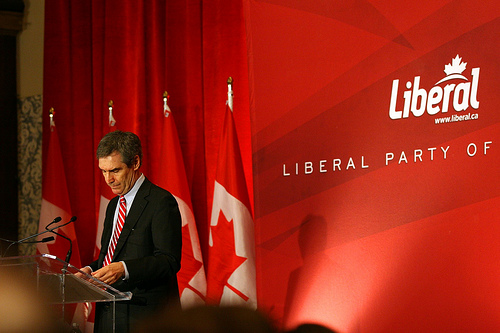
 When Michael Ignatieff resigned as leader of Canada’s Liberals at a press conference in Toronto on May 3rd, members of his team were seen at the back of the room in tears. They were grieving not just for their party—which the previous day had suffered the worst defeat in its history, coming a first-ever third place in the federal election, behind not only their Conservative Party tormentors but also the left-wing New Democrats. They were grieving even more for the death of a dream, the sad end of a six-year experiment that they had once believed would conclude with a unique man, Ignatieff himself, pulling the sword of political governance out of the stone of political theory and coming to power in Canada as a contemporary philosopher-king.
The dream could be said to have been born in the autumn of 2005, when Joseph Nye Jr., then the dean of Harvard’s Kennedy School of Government, was eating soup and sandwiches at Cambridge’s Finale restaurant with Ignatieff, his star hire. The Canadian-born journalist-historian had proved a spectacular choice to head Harvard’s new Carr Center for Human Rights Policy. In his four years there, Ignatieff had catapulted the center into prominence as an institution renowned for its policy-relevant scholarship. Among other things, Ignatieff and the Carr Center had overseen the work between human rights experts and military and intelligence officers that culminated in the US Army’s counterinsurgency strategy in Iraq.
But Ignatieff had also proved controversial. In high-profile essays and books, he had become a premier theorist of progressive imperialism. By the time of his lunch with Nye, this doctrine, which envisioned American military power being used around the world to invade and rebuild states that committed gross human rights abuses, seemed largely discredited in the eyes of the American public. Instead of American empire being “in a place like Iraq, the last hope for democracy and stability alike,” as Ignatieff had written, the US had initiated a war that had taken hundreds of thousands of Iraqi and American lives and seemed to have no end.
But Ignatieff was not deterred by the waning popularity of his ideas. He was, in fact, taking this and all the rest of his intellectual armaments into the practical realm of electoral politics. Over lunch on that fall afternoon in 2005, Ignatieff told Nye that he was leaving the comfort of Harvard life to run for a seat in the Parliament of his native Canada.
High-level scholars frequently enter government, of course, in policy or advisory roles. Nye himself worked in the Carter and Clinton administrations. But to actually run for an elected position, with the hand-shaking and the baby-kissing and the door-knocking, is not the usual career path for intellectuals, although Harvard’s own Daniel Patrick Moynihan had done it with considerable success, and figures such as Mario Vargas Llosa in Peru and of course Vaclav Havel in the Czech Republic had grasped at the brass ring of power. But it seemed to some of his colleagues at Cambridge an eccentric maneuver on the part of Ignatieff, one of the world’s most prominent thinkers, to relinquish one of the most prestigious spots at the most eminent American university to run for high office in a country where he had not lived for nearly thirty years. Yet here Ignatieff was, on his way home to Canada.
Joseph Nye himself, however, said he wasn’t surprised. “Michael had always been a public intellectual and he came from a family prominent in [Canada’s] Liberal Party,” he later said, referring to Ignatieff’s father George, a Russian émigré who became a prominent Canadian diplomat in the postwar period and was sometimes called “the greatest governor general the country never had.” (Ignatieff’s mother’s brother, George Grant, was also prominent, but as a conservative political philosopher.) Those, like Nye, who were close to Michael Ignatieff knew that he was a man of huge ambitions. He wasn’t returning to Canada to become just another ordinary, ribbon-cutting politician. He intended to become leader of the Liberals, the party that dominated twentieth-century Canada, and, ultimately, to become prime minister of one of the richest and most important countries in the world.
More than this, Ignatieff was quite consciously conducting an experiment to determine the possibilities for intellectuals in politics. The questions he wanted to answer went back to Plato and Aristotle: Should philosophers become kings? Will the mob accept or reject the wisdom of the intellectual? Or, in more modern terms: When does high-mindedness become elitism? How much must a thinker debase his ideas and ideals to gain the affections of the electorate? Ignatieff seemed to have considered these questions and was prepared to make the hard choices. Soon after making his decision he told a reporter, “There are honorable compromises and there are dishonorable ones, and you have to know the difference.”
Michael Ignatieff’s decision to jump into the flying pan of Canadian politics came as the culmination of a life of restless ambition. In 1978, at age thirty-one, he had moved to the United Kingdom from Canada, where he was a professor of history at the University of British Columbia. With his telegenic looks, natural eloquence, and erudition, Ignatieff swiftly gained prominence as a documentarian and journalist, as well as a scholar, at King’s College, Cambridge, and in London, where he published The Russian Album, a prize-winning account of his aristocratic family’s life in Russia (where they were advisers to czars) and their subsequent exile after the Bolshevik revolution. He taught not only at Cambridge, but at Oxford and the London School of Economics, and in universities in France and the United States. He won an admiring audience as a personality on the BBC and wrote a column for the Observer. He was especially well known for his books and essays from and about Yugoslavia, where more than 130,000 people died in the 1990s while Western countries delayed intervening, a lacerating experience for Ignatieff. In 1994, his book Blood and Belonging, on the problems of nationalism in the post–Cold War world, adapted from a television documentary series, won the prestigious Lionel Gelber Prize for foreign-policy books. Later on, Ignatieff wrote a biography of Isaiah Berlin and a novel called Scar Tissue that was short-listed for the 1994 Booker Prize.
But if he was the fox in many things, he was the hedgehog in one: he was above all an acute political observer and theorist who became particularly concerned with the reluctance of rich, secure states to use force to save lives. His experiences in the Balkans convinced him that American military power was crucial to advance the cause of international human rights. Writing for the New York Review of Books throughout the 1990s, Ignatieff became one of the most outspoken advocates of liberal interventionism, which was acquiring the new designation of “responsibility to protect.” (He would prepare a report with that title focusing on Kosovo and Rwanda for the International Commission on Intervention and State Sovereignty.)
Hence by the time he arrived at Harvard in 2000 to head the Carr Center, Ignatieff was already well known to the American intellectual world. His stature grew still further in the early part of the decade as he became one of the country’s most prominent public intellectuals, giving a series of lectures at Harvard called The Rights Revolution and writing a series of sophisticated essays supporting the war in Iraq for the New York Times Magazine. Accepting the assumption that Saddam Hussein was building weapons of mass destruction, Ignatieff saw Iraq not as a unique criminal enterprise ruled by an exceptionally brutal and dangerous dictator, but as a sort of petri dish where the United States could perfect the techniques that would later allow it to implement a cohesive interventionist doctrine across the globe. The essays he wrote during the early days of the War on Terror are notable not just for their full-throated backing of action in Iraq—he defended the war long after many of the other liberal interventionists had repudiated their support—but for their insights into Ignatieff’s distinctive tendency to make sweeping statements filled with broad ideas that paid little attention to local concerns or particulars. “If America takes on Iraq, it takes on the reordering of the whole region,” he wrote in a piece appropriately called “The American Empire: The Burden.” In the introduction to his 2003 book, Empire Lite, he wrote, “The central paradox, true of Japan and Germany in 1945, and true today, is that imperialism has become a precondition for democracy.” Unlike some other “liberal hawks” who recanted for their support of the war in 2003, Ignatieff kept on going. In The Lesser Evil, published a year later, he acknowledged that coercive interrogations might be needed to combat terrorism.
When he let it be known that he was leaving the US and heading north to stand for election, some Ignatieff-watchers thought they saw parallels between his grandiose ideas about American power and his grandiose political ambitions. Each involved a sense of detachment, as if the world were his instrument and he was interested primarily in seeing what he could accomplish with it. “I’ve been out of the country a while, and it seemed time to put something back,” he told the Harvard Crimson upon his departure, giving his decision an idealistic spin that was countered by the observation made by some of his colleagues that there are many ways for a citizen to give back to his native country, including, as a beginning, simply residing in it. But Ignatieff characteristically had to kick up the degree of difficulty in this midlife transit. Not only was he running for Parliament, he was aiming for the country’s highest office—prime minister. And he made no effort to conceal the all-or-nothing quality of his ambition, although he joked about his academic cushion: “If I am not elected, I imagine that I will ask Harvard to let me back.”
It turned out Ignatieff was destined to stay in Canada for a while. His impressive credentials and name recognition propelled him to victory in his first parliamentary race in 2006. Without waiting his turn, he immediately ran for the leadership of the Liberal Party, losing to Stéphane Dion after an impressive show of strength. He challenged Dion again in 2008 and this time won, his leadership being ratified at the party’s May 2009 convention. Despite attacks that he was a “parachute candidate,” many observers found something admirable about Ignatieff’s candor and his willingness to suffer the slings and arrows of the political arena. If influencing policy and public opinion is the ultimate end of political writing, Ignatieff had taken the boldest, bravest step of actually putting himself forward for consideration—something intellectuals fantasize about but rarely do. Of course, other contemporary politicians have started out as professors. George McGovern, the 1972 Democratic presidential candidate, had a doctorate in history. Newt Gingrich was a historian prior to joining the House of Representatives. Canada’s beloved Prime Minister Pierre Trudeau was a political scientist, as was Ignatieff’s predecessor as Liberal leader, Stéphane Dion. But none of these men had as prestigious a career as Ignatieff’s before leaving the university, or as much to lose; and, unlike him, they were always politicians waiting to happen. Ignatieff’s ambition seemed more organically connected with his accomplishments and more clearly a coherent outgrowth of his life’s work as an intellectual.
Instead of keeping his peace and biting his tongue while serving time, as backbencher MPs (whom Trudeau once famously described as “nobodies”) are expected to do, Ignatieff waxed philosophical on the nature of his experiment in statecraft even as it was taking place. Soon after first being elected to office in January of 2006, he told a reporter that he was fascinated by the transformation a politician must undergo in putting roots down in a community. “You suddenly have a very acute sense of what’s your turf and what’s not your turf,” he said. “Being a constituency MP is very territorial.” He described the surreal notion of driving on a road and realizing which section was in his riding. “You can go badly wrong politically if you don’t understand how important neighborhood is in urban politics. It’s much more important than I ever thought.”
Ignatieff also cataloged in detail the various difficulties he faced as he fended off increasingly vicious attacks from Conservatives and left-leaning New Democrats for his support of the Iraq War, torture, and his Mikey-come-lately status to the country. “I think this is going to be tough and it’s going to get tougher and tougher,” he said of his contemplated climb to the top. The willingness to be forthright about his self-doubt, however, always coexisted with the grandness of his ambitions. “I don’t know whether I’m up to it. I mean, I think I’m up to the job, but I don’t know whether I’m up to the price you have to pay,” he said, sounding a bit like Macbeth. As part of his public introspection, he conceded he had a reputation for cruelty with family members and friends. “I am someone who has worried greatly about the price my ruthlessness has inflicted on others. I have worried about that. I do worry about that . . . you do get up in the night and think of that.”
Despite his considerable personal assets, Ignatieff had a steep learning curve as a politician. In his first year in office, a Liberal leadership race erupted (precipitated by him), as did Israel’s war against Hezbollah in Lebanon. Both events showed him to have a slow grasp on the nuts and bolts of holding coalitions together and maintaining friends without alienating allies. Though he was leading the Liberal leadership race right up to the party convention in 2006, he was ultimately out-maneuvered by Stéphane Dion, nobody’s idea of a consummate tactician. Ignatieff also found himself in trouble for his remarks on the Hezbollah war, after first declaring that he was “not losing sleep” over Lebanese casualties and then abruptly declaring Israel guilty of “war crimes.” He apologized for both comments and was decidedly mum on the conflict ever after. “I’ve spent my life as a writer, but you have no idea of the effect of words until you become a politician,” he told the New Yorker with a sense of wonder. “One word or participle in the wrong place and you can spend weeks apologizing and explaining.”
At the same time that the navel-gazing was taking place, however, Ignatieff was becoming a consequential MP, showing political courage as well as naïveté. He was one of the few Liberals in 2006 to join the Conservative government in voting to extend Canada’s mission in Afghanistan and made supporting the war the centerpiece of his ill-fated and premature leadership campaign that year. The Liberals had originally opposed Canadian troop deployment in the country beyond 2007. But the Conservative government wanted to stay in Afghanistan indefinitely, and accused the Liberals of being soft on the war. Given Ignatieff’s record of humanitarian concern, abandoning the Afghans to the Taliban was especially problematic. It fell to him to broker a compromise—he devised a new Liberal policy of extending the mission until 2009. The Conservatives agreed. As Liberal leader, Ignatieff bridged the divisions between parties, making Canadian foreign policy bipartisan. More personally, he had achieved the intellectual’s ultimate dream: bringing ideas—in this case, interventionist ideas—into being in the real world of politics. “The thing that Canadians have to understand about Afghanistan is that we are well past the era of Pearsonian peacekeeping,” he said, referring to former Prime Minister Lester Pearson, whose work in negotiating an end to the Suez Crisis won him the Nobel Prize in 1957. Ignatieff’s vision offered a harsh either/or choice to Canadians, who in the last few decades have gravitated toward the semi-neutralism of conflict resolution through international agencies rather than following the US.
Ignatieff also seemed to make a concerted effort to improve the quality of dialogue in the House of Commons, which often seems less like a debating house between statesmen than a fire in a barnyard. Maclean’s, Canada’s major newsweekly, labelled Ignatieff as the “best orator” in Parliament for his “profound” use of alliteration and flights of Ciceronian rhetoric. “Mr. Speaker, you can’t get development, diplomacy, and defense to work together in Kandahar if you’ve got muddle, misinformation, and mismanagement in Ottawa,” he once said. “You can’t win hearts and minds in Afghanistan, if all they see are troops, tanks, and guns.”
And yet, despite these successes, Ignatieff never managed to overcome his pedigree. “I’m not in a Hamlet-like state of indecision,” he said before announcing his successful 2009 run for Liberal leader, an allusion guaranteed to pass over the heads of the vast majority of the voters. Using Hamlet to dispute the notion that he was a pretentious intellectual was very intellectual, and very much unlike the reflex of a more natural politician such as Ronald Reagan, who used Rambo, Reader’s Digest, and Back to the Future in making sure he was not speaking over the heads of Americans. “Canadians have not warmed to Mr. Ignatieff because he can come off as being intellectual, a little aloof and ill at ease with people,” as one pollster said with understatement.
Ignatieff became Liberal Party leader, but the intellect and eloquence that had catapulted him to this pinnacle in record time would also be responsible for his political undoing. A silver tongue (and spoon), as he discovered, was not enough. The nakedness of Ignatieff’s ambition, the sheer audaciousness and presumption involved, was off-putting to Canadians. The Conservatives effectively labelled him as a man “just visiting” the country. In addition, he faced some structural problems. Though introduced by a Liberal prime minister in 2002, a law mandating stringent campaign finance laws resulted in major advantages for the Conservatives. The Tories, maintaining a superior grassroots funding initiative, were able to tap into vast reserves of cash unavailable to Ignatieff and company. The result was an endless barrage of unanswered ads targeting Ignatieff personally as a carpetbagger.
In addition, Ignatieff was unfortunate in having incumbent Prime Minister Stephen Harper as his chief rival while jockeying for the nation’s top job. As good a political animal as the Conservatives have had in half a century, Harper proved himself at every step a shrewder strategist than Ignatieff. Harper could always claim, for instance, to be the most hawkish party leader on Afghanistan, for while Ignatieff was able to stretch his party’s position on the war, it was not possible for him to be more right-wing than the Conservatives. When the global financial crisis erupted in 2008, Harper successfully suggested that Ignatieff’s proposed tax increases would hamper economic recovery. And when Canada rebounded from the recession, much more swiftly than America did, Harper took credit. Similarly, much as Al Gore was unable to best George W. Bush at the podiums, despite his presumed superior intelligence, Ignatieff proved surprisingly incapable of outclassing Harper during the election campaign’s televised debates. Ignatieff appeared at times too clever by half; the folksy Harper consistently spoke directly into the camera and deflected the many attacks sent his way.
Ignatieff suffered completely avoidable self-inflicted wounds as well. In prematurely announcing his intention to force an election in September of 2009, he lost a large section of the Canadian voters, who, having already suffered through four federal elections in the 2000s, were hostile toward the prospect of another one unless absolutely necessary. His book True Patriot Love, released the same year, was a ham-handed attempt to establish his Canadian bona fides. “Loving a country is an act of imagination,” he wrote in the book, a line which caused one reviewer to quip, “I’m not even sure what it means, but you wouldn’t write that if you were really secretly a Harvard professor at heart. Right?” Ignatieff never overcame the impression that he was in the country only insofar as he could profit from it. He suffered from the fact that intellectuals do insincerity much more clumsily than do “natural” politicians. After making a major push to fight climate change in his leadership run, for instance, he quickly jettisoned the idea in favor of a toothless but more popular Liberal plan devoid of specific targets. “You’ve got to work with the grain of Canadians and not against them,” he declared weakly.
And then came the election itself on March 3rd, a train wreck for the party Ignatieff led even more than an Icarus-like fall to earth for the candidate himself. The Liberals, heirs to the oldest party in Canada, were reduced from seventy-seven seats to thirty-four. So precipitous was the fall that they found themselves in third place behind the New Democrats, a left-wing party whose strength had been previously contained within unions and the universities. Ignatieff had dared to envision the restructuring of Canadian politics. And indeed, he helped make it happen. But what occurred was far different from what he had imagined.
This is a tale with many morals. But one clear takeaway from Michael Ignatieff’s attempt to storm the citadel of power in Canada is that makeovers, particularly by intellectuals trying to transform themselves into politicians, have limits. Once Ignatieff established himself as a cosmopolitan free thinker and intellectual entrepreneur, it was difficult for him ever to posture as an ordinary Canadian pol. Most intellectuals looking to enter politics presumably would not hamstring themselves by living outside their native country for nearly three decades and then return only to aim so soon for the top job. And perhaps only an intellectual would be detached enough to believe such a track record would not be an impediment to leading a country. But if Ignatieff’s palpable erudition provided an occasional warning sign for his ambitions, as seen in those Hamlet-like meditations on power, it also gave him a sense that he was not subject to the rules that govern more mundane careers.
Becoming Liberal leader in a few short years and dramatically impacting the nation’s public dialogue is not an inconsiderable achievement, even if Ignatieff’s ultimate goals were not ultimately reached. It may be difficult for philosophers to become kings, but just by being in the royal palace they are able to have some influence.
Having raised such monumental expectations—he was repeatedly compared to Pierre Trudeau, gold standard of liberalism, upon his arrival in Canadian politics—Michael Ignatieff disappointed many in his rapid rise and fall. When he departs the country, as he inevitably will, he will leave behind many what-ifs. Instead of a has-been, Ignatieff will be portrayed by some as a never-was. But such a verdict would be at best a partial and unfair judgment. Ignatieff has a first-rate intellect and a second-rate temperament—the reverse of the famous judgment on FDR—and he’ll always have Harvard.
Jordan Michael Smith is a Canadian writer living in Washington, DC. He has written for the New York Times, the Boston Globe, and Newsweek. Article publicat al World Affairs Journal, juliol/agost 2011.
M'agrada S'està carregant...

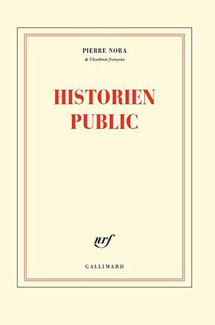
 Il est rare qu’une figure publique pèse autant que sa valeur réelle, mais c’est le cas avec Pierre Nora. Ce que le lecteur retient de ses nouveaux livres – tous deux collection d’écrits antérieurs -, c’est que l’historien n’est pas réductible à son pedigree. Son rôle éditorial chez Gallimard, ses liens avec l’establishment intellectuel français, la fondation de la revue Le Débat… ne sont pas l’essentiel. Même son rôle de “sourcier de l’identité nationale”, qui est devenu un titre de gloire ou un épouvantail selon les points de vue, n’est plus central, comme je le croyais à la publication des Lieux de mémoire il y a vingt ans – raison pour laquelle je l’avais critiqué à l’époque.
 Etienne Borne au lycée parisien Louis-le-Grand : “Le Philosophe est donc l’interprète d’une vérité qui se dérobe – qui se “dérobe”, dirait-on volontiers, au sens où elle échappe comme au sens où elle se dévoile. Il n’y a pas de vérité philosophique, mais une interprétation philosophique de toutes les vérités qui ne sont vraies que par rapport à cette interprétation. La philosophie comme savoir total, qui serait située entre, par exemple, la science et la religion, est une mystification.” Ici se trouve la clé du grand apport à l’histoire que donnera Pierre Nora : avec d’autres, il a contribué à remettre en question l’enseignement positiviste, qui réduit l’histoire au pur déroulement des événements. Pour lui, quel que soit le sujet, l’histoire peut affronter des vérités (des mémoires) divergentes.
 Plus proche d’un Renan que d’un Lavisse, Pierre Nora possède l’ironie habile du premier, mais aussi une plus grande capacité à supporter l’ambiguïté. Le philosophe et historien Ernest Renan, qui a écrit la conférence la plus célèbre du XIXe siècle, Qu’est-ce qu’une nation ?, aimait trancher là où souvent Nora reste dans ce que le poète John Keats appelait la “capacité négative”, le pouvoir de résister au jugement hâtif. Au moins comme éditeur, sinon toujours en tant qu’intellectuel engagé dans le débat public.



 NACIONALITATS & POLÍTICA